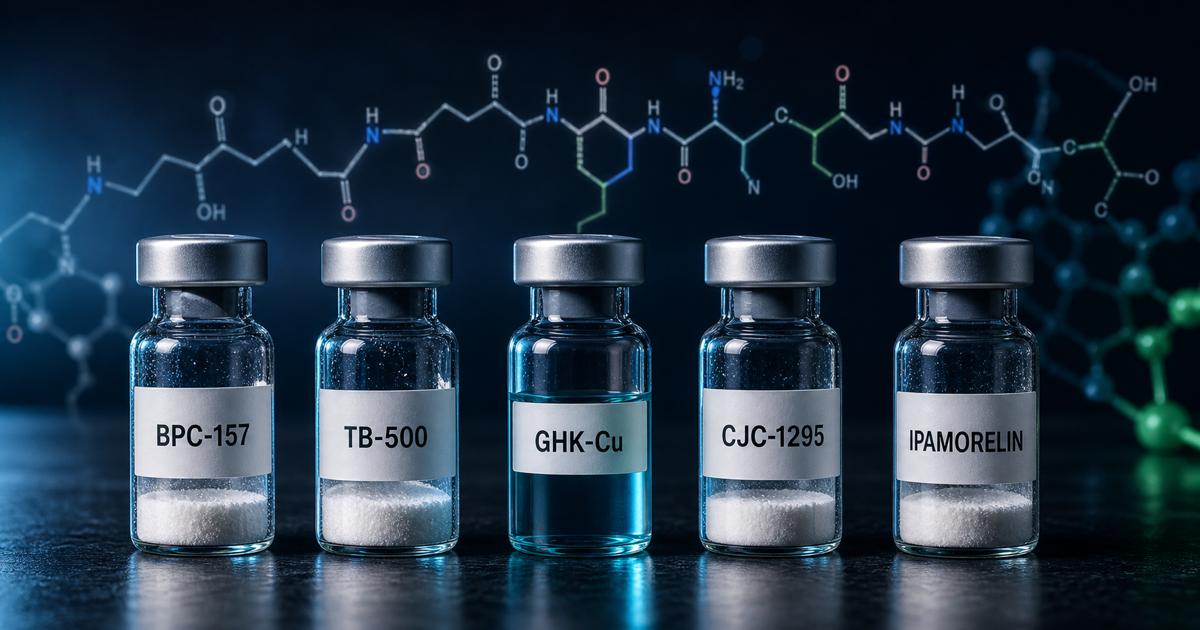
From a chemical perspective, peptides are a vast group of molecules made of chains of amino acids. But when people talk about “peptides” today in podcasts, fitness circles, or the longevity community, they usually mean a much narrower group of bioactive substances that target specific processes in the body — such as appetite, hormonal signaling, or mechanisms studied in connection with recovery.
Both meanings are correct; they simply describe different things. In chemistry, a peptide is a type of molecule. In contemporary online language, “peptides” is a contextual shorthand for several dozen physiologically interesting substances, from semaglutide (Ozempic) and tirzepatide (Mounjaro) to CJC-1295, BPC-157, and TB-500.
The fact that two substances are peptides does not mean they work in similar ways. One may be a thoroughly studied medicine, while another may only have results from animal research. Products offered by non-transparent or questionable sellers may also lack reliable evidence of the identity, purity, or amount of the declared substance. That is not a property of the peptide itself, however, but a question of quality control for the specific product.
What is a peptide from a chemical perspective?
A peptide is a short chain of amino acids connected by peptide bonds. Proteins are made from the same building blocks, but their chains tend to be longer and fold into complex three-dimensional structures. Put simply, a peptide can be understood as a shorter relative of a protein. The exact boundary between them is not fixed, however, and depends on the particular biological or regulatory context. For example, the FDA classifies some synthetic drug substances containing no more than 40 amino acids as peptides, but this is not a universal biological rule.1
The chemical definition alone does not tell us what a molecule does in the body. Peptides can have many different roles — for example, they can act as hormones or influence immune-system activity.2 There is therefore no single shared “peptide effect,” just as all medicines in tablet form do not have one shared effect simply because they use the same dosage form.
Outside the biohacking world, the word peptides also refers to other substances, including cosmetic ingredients and common medicines. On this blog, we focus primarily on bioactive peptides and their analogues — substances used or studied with the aim of influencing human physiology in a targeted way.
Why do people talk about certain peptides in particular?
Some peptides have become popular mainly because of extraordinary-sounding user experiences. Online communities, for example, feature claims of dramatically faster healing after BPC-157 or effortless tanning after melanotan II. To someone dealing with an injury, appearance, or weight loss, stories like these can make a substance sound almost miraculous.
Striking personal experiences spread easily through podcasts, social media, and user communities. They may draw attention to an interesting substance, but on their own they do not show how often the same effect occurs or whether the peptide actually caused it. Without a controlled study, a personal experience cannot be reliably separated from factors such as the natural course of healing or other simultaneous changes.
The fact that a peptide looks like an extraordinary discovery online therefore does not make it a proven medicine. Drug development evaluates an investigational substance by multiple criteria, including how long it acts in the body and whether its use is sufficiently safe. An interesting mechanism and enthusiastic user reports are not enough on their own. Most candidates never even reach large-scale trials.
A natural peptide and a synthetic analogue are not the same thing
The common claim that “peptides occur naturally in the body” applies only to some substances. In practice, it is useful to distinguish four broad groups, which may partially overlap:
- Endogenous peptides are produced by the human body itself. One example is the tripeptide GHK, which is present in human blood and binds copper to form a complex known as GHK-Cu.3
- Analogues of endogenous peptides are based on a natural molecule, but their sequence or structure has been modified. Semaglutide, for example, is an analogue of the natural hormone GLP-1.4 A modification may extend the biological half-life or increase resistance to enzymes.
- Peptide fragments represent only a particular part of a larger natural molecule. With the name TB-500, it is therefore important to distinguish the seven-amino-acid fragment LKKTETQ from full-length thymosin beta-4.5
- Novel synthetic peptides are not merely copies of a natural human signal and may contain non-natural amino acids or other laboratory modifications. Ipamorelin is a synthetic pentapeptide that activates the ghrelin receptor; it is not ghrelin itself.5,6
The words synthetic and analogue are therefore not synonyms. Synthetic describes how something is manufactured in a laboratory. Analogue describes its relationship to the original molecule. A laboratory can produce an exact copy of a natural peptide, a modified analogue, or an entirely new sequence.
These modifications are one reason peptides can work as practical medicines. A natural signaling molecule may remain in the body for only a few minutes because enzymes break it down quickly. An analogue designed in a laboratory may act for substantially longer.2
This leads to another important point: natural does not automatically mean safe. The body releases its own signals in a particular place, at a particular time, and in a precisely regulated amount. External administration can create a different concentration, duration of action, and distribution throughout the body. These differences may be even greater with a synthetic analogue.
A map of peptides known from biohacking
The following overview is not a list of the most important peptides in biology. It shows substances that often appear in discussions about weight loss, recovery, hormones, sexual function, or longevity. The column “why people seek it out” describes users' motivations, not necessarily a proven effect.
| Substance | Type or main target | Why people seek it out | What the data support so far |
|---|---|---|---|
| Semaglutide (Wegovy for weight management; Ozempic for type 2 diabetes) | GLP-1 analogue and GLP-1 receptor agonist | weight loss, reduced hunger, glycemic control | large controlled trials for specific populations and outcomes4,7 |
| Tirzepatide (Mounjaro) | dual GIP and GLP-1 receptor agonist | weight loss and metabolic control | large controlled trials for specific populations and outcomes8 |
| Retatrutide | GIP, GLP-1, and glucagon receptor agonist | weight loss and metabolic effects | a substantial effect in phase 2; the phase 3 TRIUMPH-1 trial had been completed, but its registry entry did not include results as of July 16, 20269,10 |
| BPC-157 | synthetically manufactured 15-amino-acid peptide; its mechanism in humans is not established | healing of tendons, muscles, and the gastrointestinal tract | predominantly preclinical data; a three-day safety pilot in two previously exposed people cannot establish safety for the wider population11,5 |
| TB-500 | a name associated with a fragment of thymosin beta-4 | healing and recovery after injury | convincing data on administration of the TB-500 fragment itself to humans are lacking; findings for full-length thymosin beta-4 cannot automatically be transferred to it5 |
| CJC-1295 with DAC | long-acting GHRH analogue | increased GH and IGF-1, recovery, body composition | a small study in healthy people showed increased GH and IGF-1, not the claimed changes in recovery or body composition; the result concerns the DAC variant12 |
| Ipamorelin | ghrelin receptor agonist and growth-hormone secretagogue | growth hormone, recovery, and sleep | a small study in volunteers confirmed a hormonal response but did not demonstrate clinical benefit for these goals6 |
| Tesamorelin | GHRH analogue | reduced visceral fat | controlled trials demonstrated a reduction in visceral fat in people with HIV and excess abdominal fat; this does not establish the same effect in other populations13 |
| GHK-Cu | natural tripeptide that forms a complex with copper | skin, hair, and healing | many findings come from cells and animals; topical and injectable use have different evidence and risks5,3 |
| Melanotan II | synthetic analogue of a melanocortin peptide | tanning and libido | only small human studies exist for some effects, along with published safety signals5,14 |
| MOTS-c | mitochondrial-derived peptide | metabolism, performance, and longevity | the original attractive metabolic findings come mainly from cells and mice; data on administration to humans are insufficient5,15 |
| Bremelanotide | melanocortin receptor agonist | sexual desire | two large controlled trials demonstrated an effect in a specifically defined group of women; these results cannot be used as evidence that melanotan II is effective16 |
Not all evidence carries the same weight
With peptides, it is easy to mistake a biologically interesting finding for a proven effect. If a substance affects cells in a laboratory or accelerates healing in an animal, that is a reason for further research, not evidence that it will help a human in the same way.
Only studies in humans can show whether a substance actually delivers the expected outcome and what risks it carries. Even human studies do not always have the same evidential value: a small preliminary study provides less certainty than large-scale controlled research.
Are peptides safe?
This question cannot be answered for the category as a whole. A short chain of amino acids may be a natural hormone, a thoroughly tested analogue, or an almost unexplored molecule. Safety depends on many circumstances, including the specific substance, its dose, and a person's health.
Similarly, a peptide cannot be called safe just because it mimics something natural. Strengthening a physiological signal may be the aim of treatment, but it can also cause adverse effects. And data obtained for one population, one formulation, and one route of administration cannot automatically be transferred to another use.
Why aren't there large studies for every peptide?
Clinical trials and consistent pharmaceutical manufacturing are expensive. But that is not the only explanation. An investigational substance may, for example, act for too short a time in the body or fail when research moves from animals to humans. Sometimes it may not offer enough benefit over existing treatment, or further development may not be financially viable.
The absence of a large study therefore does not mean that a substance definitely does not work. But neither does it mean that it works and simply no one wants to study it. Above all, it means greater uncertainty.
This is also related to a widespread patent myth. Some exact natural molecules may have more limited options for patent protection, but their natural origin does not automatically exclude such protection. Modified analogues or new methods of using them may, for example, be patentable.17
What to take away
Peptide is a chemical category, not a promise of a particular effect. The contemporary online meaning of the word is much narrower: it refers to a group of bioactive substances attracting attention in connection with weight loss, recovery, hormones, sexual function, or longevity. Individual substances differ fundamentally in their mechanisms and in the amount of human data available. For marketed products, transparency of origin and documented quality control for the specific batch are separate questions.
For each particular peptide, it therefore makes sense to ask four questions:
- What exactly is this substance — a natural peptide, an analogue, a fragment, or a novel synthetic structure?
- Which biological mechanism does it actually affect?
- What human data exist, and what exactly did the studies measure?
- Does the seller document the identity, purity, and quality control of the specific product?
Only answers to all four make it possible to distinguish an interesting mechanism from a proven treatment, and a marketing claim from documented information about a specific product.
Sources
-
U.S. Food and Drug Administration. ANDAs for Certain Highly Purified Synthetic Peptide Drug Products That Refer to Listed Drugs of rDNA Origin: Guidance for Industry. 2021. FDA guidance ↩
-
Lau JL, Dunn MK. Therapeutic peptides: Historical perspectives, current development trends, and future directions. Bioorg Med Chem. 2018;26(10):2700–2707. PMID 28720325 ↩ ↩2
-
Ufnalska I, et al. Intermediate Cu(II)-thiolate species in the reduction of Cu(II)GHK by glutathione: a handy chelate for biological Cu(II) reduction. Inorg Chem. 2021;60(23):18048–18057. PMID 34781677; Badenhorst T, Svirskis D, Wu Z. Physicochemical characterization of native glycyl-L-histidyl-L-lysine tripeptide for wound healing and anti-aging: a preformulation study for dermal delivery. Drug Dev Ind Pharm. 2016;42(2):152–160. PMID 25384620; Wang X, et al. GHK-Cu-liposomes accelerate scald wound healing in mice by promoting cell proliferation and angiogenesis. Wound Repair Regen. 2017;25(2):270–278. PMID 28370978 ↩ ↩2
-
Wilding JPH, et al. Once-weekly semaglutide in adults with overweight or obesity. N Engl J Med. 2021;384:989–1002. PMID 33567185 ↩ ↩2
-
U.S. Food and Drug Administration. Certain Bulk Drug Substances for Use in Compounding that May Present Significant Safety Risks. Current version checked July 16, 2026. FDA ↩ ↩2 ↩3 ↩4 ↩5 ↩6 ↩7
-
Gobburu JVS, et al. Pharmacokinetic-pharmacodynamic modeling of ipamorelin, a growth hormone releasing peptide, in human volunteers. Pharm Res. 1999;16(9):1412–1416. PMID 10496658 ↩ ↩2
-
European Medicines Agency. Wegovy and Ozempic: registration overviews and therapeutic indications. Checked July 16, 2026. Wegovy; Ozempic ↩
-
Jastreboff AM, et al. Tirzepatide once weekly for the treatment of obesity. N Engl J Med. 2022;387:205–216. PMID 35658024 ↩
-
Jastreboff AM, et al. Triple-hormone-receptor agonist retatrutide for obesity — a phase 2 trial. N Engl J Med. 2023;389:514–526. PMID 37366315 ↩
-
U.S. National Library of Medicine. A Study of Retatrutide (LY3437943) in Participants Who Have Obesity or Overweight (TRIUMPH-1). ClinicalTrials.gov NCT05929066. Status and results checked July 16, 2026. ClinicalTrials.gov ↩
-
Lee E, Burgess K. Safety of intravenous infusion of BPC157 in humans: a pilot study. Altern Ther Health Med. 2025;31(5):20–24. Two participants, both of whom had previously received intravenous BPC-157; no control group, with follow-up through day three. PMID 40131143 ↩
-
Teichman SL, et al. Prolonged stimulation of growth hormone and insulin-like growth factor I secretion by CJC-1295, a long-acting analog of GH-releasing hormone, in healthy adults. J Clin Endocrinol Metab. 2006;91(3):799–805. PMID 16352683 ↩
-
Falutz J, et al. Effects of tesamorelin in HIV-infected patients with abdominal fat accumulation: a randomized placebo-controlled trial with a safety extension. J Acquir Immune Defic Syndr. 2010;53(3):311–322. PMID 20101189 ↩
-
Wessells H, et al. Effect of an alpha-melanocyte stimulating hormone analog on penile erection and sexual desire in men with organic erectile dysfunction. Urology. 2000;56(4):641–646. The study included ten men. PMID 11018622 ↩
-
Lee C, et al. The mitochondrial-derived peptide MOTS-c promotes metabolic homeostasis and reduces obesity and insulin resistance. Cell Metab. 2015;21(3):443–454. PMID 25738459 ↩
-
Kingsberg SA, et al. Bremelanotide for the treatment of hypoactive sexual desire disorder: two randomized phase 3 trials. Obstet Gynecol. 2019;134(5):899–908. PMID 31599840 ↩
-
United States Patent and Trademark Office. MPEP § 2106 — Patent Subject Matter Eligibility. USPTO; European Patent Office. Guidelines for Examination, G-II, 3.1 — Discoveries. EPO ↩