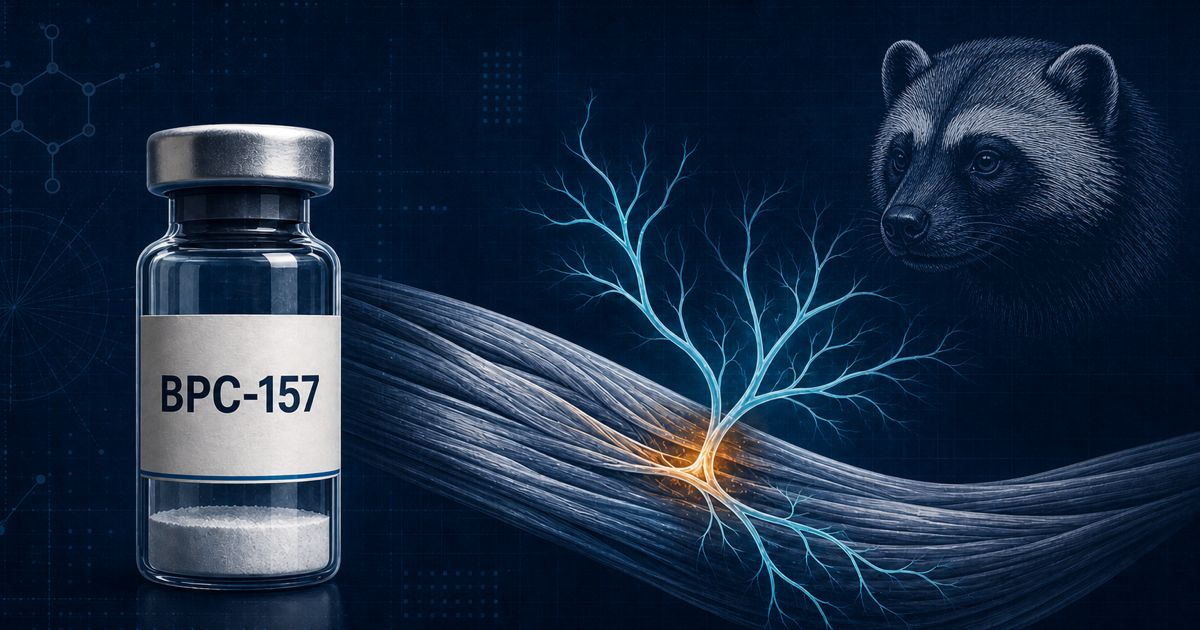
BPC-157 has an almost miraculous reputation online. Together with TB-500, it also forms the basis of the so-called Wolverine stack, a combination named after the comic-book hero known for his extraordinary ability to heal. People write that BPC-157 completely healed a chronic injury they had lived with for years, or that after surgery they heard a doctor say, “I've never seen ligaments heal this quickly.” One anonymous user, for example, described long-standing tennis elbow; after using BPC-157, the symptoms disappeared after six weeks.1
Stories exactly like these explain why BPC-157 is described as a miracle. But is it really one? We often do not know exactly how a person administered the substance, whether the injury had begun to heal on its own, or what role rehabilitation may have played. And alongside enthusiastic accounts are people who did not experience any marked effect after using the peptide.2
When we look at research rather than internet forums, a large gap emerges: many animal experiments appear promising, while human data are limited to a few small studies.
That does not mean BPC-157 does not work. It means that an exceptionally wide gap remains between its reputation and what has actually been demonstrated in humans.
Potential benefits of BPC-157
Research on BPC-157 has repeatedly described several areas in which it may have beneficial effects, mostly in animal and laboratory models:3
- protection of the stomach and intestines in models of damage caused by alcohol, stress, or medicines;
- faster healing of tendons, muscles, ligaments, bones, skin, and peripheral nerves;4
- changes in the inflammatory response;
- changes in blood-vessel formation and blood flow;5
- possible neuroprotective effects.
People online also report faster recovery after training, less muscle soreness and inflammation, being able to exercise more often, and relief from gastrointestinal problems, such as Crohn's disease.6
The best-known studies concern Achilles tendon healing. In a 2003 study, researchers transected the tendons of rats and then observed how strongly and quickly they healed. The animals given BPC-157 did better than the control group.4 Laboratory findings also suggest that BPC-157 could affect the formation of new blood vessels and other tissue-repair processes.5
This sounds promising, but it is important to note where these findings come from: predominantly laboratory experiments in animals. An artificially created injury in a rat is not the same as a human sports injury, and the results may not carry over to ordinary use in humans.7 Reliable evidence that the same effect occurs in humans is still lacking.
What BPC-157 actually is
BPC-157 is a small peptide made up of fifteen amino acids. BPC stands for Body Protection Compound, and 157 refers to the specific peptide fragment. BPC-157 was originally described as part of a larger protein present in human gastric juice.8
Research on it is associated primarily with Croatian pharmacologist Predrag Sikirić and his colleagues. Since the 1990s, they have tested BPC-157 mainly in animals with damage to the stomach, tendons, muscles, nerves, and blood vessels. It is precisely this breadth of positive findings that created the reputation of a substance capable of protecting almost everything.
Why it has a reputation as a “miracle peptide”
The story is almost ideal for the internet. Tendons heal slowly, standard rehabilitation takes months, and many people have pain that keeps coming back. When someone then writes that their pain suddenly disappeared after weeks without progress, it is easy to believe they have found a solution that others have overlooked.
The popularity of BPC-157 is also growing quickly. People discuss it on specialist forums, and an increasing number of videos, podcasts, and social-media posts are being made about it. According to an FDA briefing document, content labelled BPC-157 on YouTube and TikTok has accumulated more than 50 million views.3 Google Trends also shows that global interest grew gradually for several years, accelerated sharply during 2025, and reached an all-time high in 2026.9
That is the heart of the debate. A large number of similar experiences is not worthless — it is a reason to conduct rigorous research. But it is not a substitute for that research. This is especially important with tendon and muscle injuries: the condition often improves with time and good rehabilitation even without an experimental substance.
Why do people talk so much about blood vessels and blood flow?
Tendons are notoriously poorly supplied with blood, which is why they often heal slowly after injury. Blood brings oxygen, nutrients, and cells involved in healing to the repair site; when that supply is limited, the body has far fewer resources from which to rebuild damaged tissue. The idea that a substance might support the formation of new blood vessels or restore blood flow is therefore very appealing to someone with a long-standing tendon problem.10
Laboratory experiments and animal studies have suggested precisely such a mechanism for BPC-157: it affected signalling through the VEGFR2 receptor, promoted blood-vessel formation, and accelerated the return of blood flow in ischemic muscle in rats.5 This may explain why BPC-157 is so often associated with tendon and ligament healing.
This process of forming new blood vessels is called angiogenesis. In healing, it is beneficial because it brings oxygen, nutrients, and the cells needed for repair into damaged tissue. This is also where the biggest theoretical concern comes from: if BPC-157 increased blood-vessel formation around an existing tumour as well, it could, just as it might for an injured tendon, bring the tumour more oxygen and nutrients and thereby support its growth. Tumours can use newly formed blood vessels to obtain the oxygen and nutrients they need to continue growing.11 With BPC-157, however, this possibility is only theoretical. It has not been demonstrated in humans that BPC-157 promotes tumour growth or causes cancer.3
Risks: what we know and what we can only suspect
The biggest problem is that there are not enough data for a reliable list of risks.
- Limited safety data: short human studies included few people and cannot reveal rare or long-term risks.3
- Blood-vessel formation and tumours: this is a theoretical risk, explained in more detail above in the section on angiogenesis.
- Mood: some people on forums describe emotional blunting or anhedonia, an inability to experience pleasure; these are personal experiences, not clinical data.12
What to take away
For a practical overview of the doses, frequency, and cycle lengths reported in the community, see BPC-157 dosage: how much, how often, and for how long.
BPC-157 is not merely internet marketing. There are many very promising personal experiences surrounding it. It also has a long history of animal experiments that have repeatedly produced positive results. Taken together, that is enough reason to investigate BPC-157 rigorously.
At the same time, the most important point cannot be skipped: we do not know whether BPC-157 truly accelerates healing in humans, who it might harm, or what happens with repeated or long-term use. BPC-157 therefore remains a promising hypothesis with an exceptionally strong online reputation — not a proven treatment.
Sources
-
TendonRepairGuy. Tennis Elbow Gone After 6 Weeks — BPC-157 Experience Report. SubstanceWiki, 2026. Personal experience, not a verified study. Tennis-elbow experience. ↩
-
Users of the MESO-Rx forum. Bpc-157 dosage personal experiences? Various personal experiences, including reports of no marked improvement; this is not a clinical study. MESO-Rx discussion. ↩
-
U.S. Food and Drug Administration. Evaluation of BPC-157-Related Bulk Drug Substances (BPC-157 Free Base and BPC-157 Acetate) for Inclusion on the 503A Bulk Drug Substances List. Pharmacy Compounding Advisory Committee briefing document. 2026. FDA briefing document. ↩ ↩2 ↩3 ↩4
-
Staresinic M, Sebecic B, Patrlj L, et al. Gastric pentadecapeptide BPC 157 accelerates healing of transected rat Achilles tendon and in vitro stimulates tendocytes growth. J Orthop Res. 2003;21(6):976–983. DOI: 10.1016/S0736-0266(03)00110-4. ↩ ↩2
-
Hsieh MJ, Liu HT, Wang CN, et al. Therapeutic potential of pro-angiogenic BPC157 is associated with VEGFR2 activation and up-regulation. J Mol Med. 2017;95(3):323–333. DOI: 10.1007/s00109-016-1488-y. ↩ ↩2 ↩3
-
Examples of user experiences: r/bpc_157: “Does bpc help with muscle recovery from workouts?”, r/bpc_157: “Bpc for muscle growth despite its intended usages”, and r/bpc_157: “BPC 157 with Crohn's disease”. Records retrieved July 29, 2026. ↩
-
He L, Feng D, Guo H, et al. Pharmacokinetics, distribution, metabolism, and excretion of body-protective compound 157, a potential drug for treating various wounds, in rats and dogs. Front Pharmacol. 2022;13:1026182. DOI: 10.3389/fphar.2022.1026182. ↩
-
Sikirić P, Petek M, Rucman R, et al. A new gastric juice peptide, BPC. An overview of the stomach-stress-organoprotection hypothesis and beneficial effects of BPC. J Physiol Paris. 1993;87(5):313–327. PubMed PMID 8298609. ↩
-
Google Trends. Worldwide relative interest in the search query “BPC-157” from 2004 to the present. A value of 100 indicates the highest point of interest during the selected period, not an absolute number of searches. Google Trends. Verified August 2, 2026. ↩
-
Schulze-Tanzil GG, Delgado-Cáceres M, Stange R, Wildemann B, Docheva D. Tendon healing: a concise review on cellular and molecular mechanisms with a particular focus on the Achilles tendon. Bone Joint Res. 2022;11(8):561–574. DOI: 10.1302/2046-3758.118.BJR-2021-0576.R1. The authors describe tendon as a hypovascular tissue and note that excessive pro-angiogenic signalling may lead to persistence of immature healing tissue. ↩
-
National Cancer Institute. What Is Cancer? Tumour cells can support the growth of blood vessels that bring oxygen and nutrients to the tumour. National Cancer Institute. Verified August 2, 2026. ↩
-
Examples of personal experiences of anhedonia after BPC-157, not clinical evidence: r/bpc_157: “Bpc-157 Causing Anhedonia, Depression, Anxiety, and negative thoughts” and r/bpc_157: “Experiences with Anhedonia?”. Records retrieved July 29, 2026. ↩